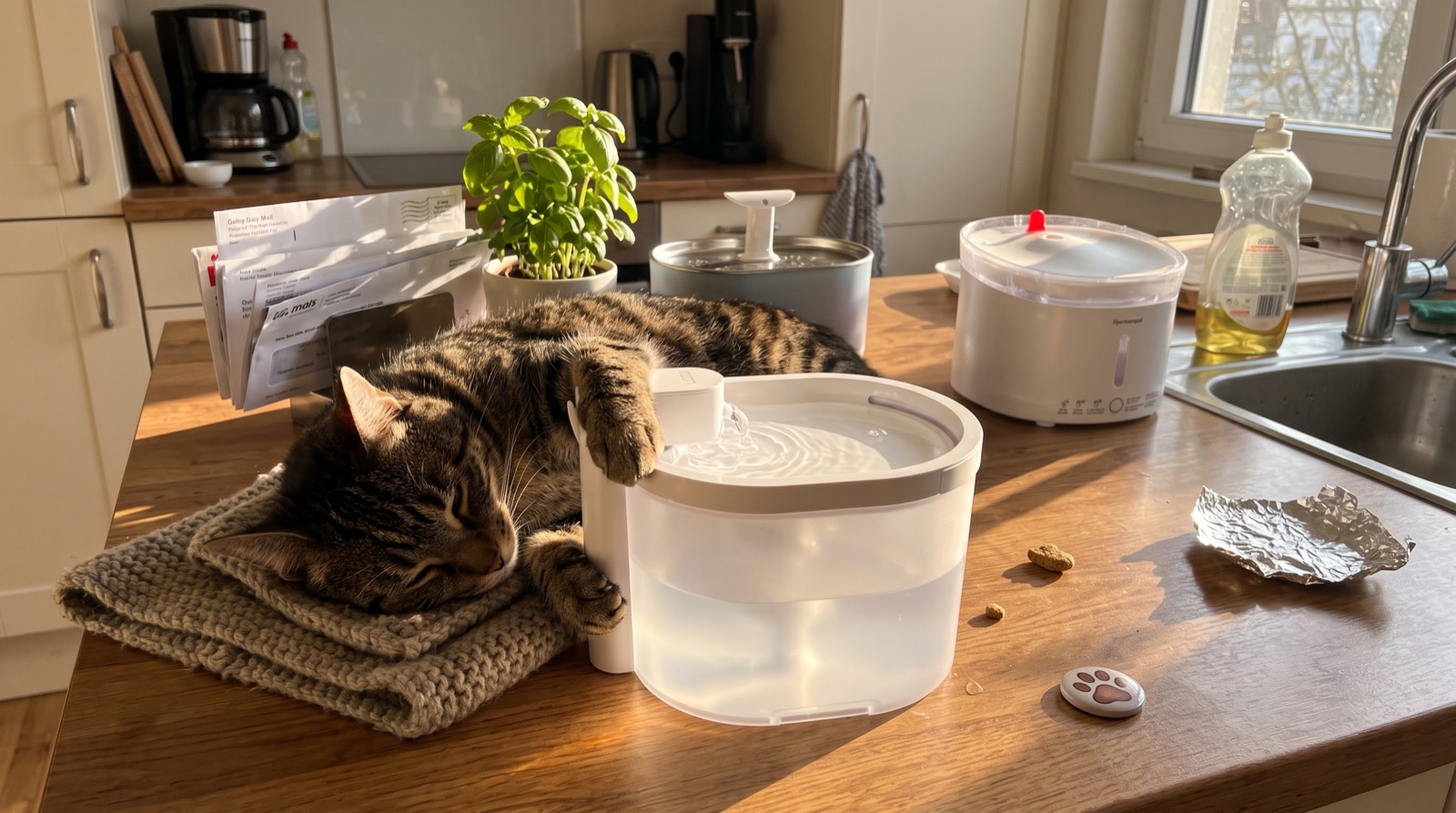
We Tested 14 Cat Water Fountains Over 6 Weeks. Only One Actually Solved the Problem.
By Sarah Calloway | Senior Pet Product Reviewer | Updated April 16, 2026
Independently TestedNo Brand Sponsorships6 Weeks of Real-World Use
If you've landed here, I already know three things about you.
You've bought at least one cat fountain before. Maybe two. Maybe five. The first one worked great for about a month before the motor started buzzing like a dying refrigerator. The second one looked beautiful on the website, then you pulled the filter chamber apart at week three and almost gagged at the slimy film coating the inside. And somewhere along the way, you started wondering whether the "stainless steel" fountain you paid $80 for is actually stainless steel — or whether the stainless part is just the dish your cat licks, while every other drop of water is passing through plastic, plastic, and more plastic.
I've been there. Actually — let me back up and introduce myself, because I'd want to know who's talking before I trusted a word of this.
I'm Sarah Calloway, and I'm not a vet or an engineer. I'm just a cat owner with three very opinionated roommates. There's Juniper, my 13-year-old Maine Coon, who is roughly the size of a raccoon and twice as dramatic. There's Milo, a 4-year-old orange tabby who refuses to drink from a bowl but will throw himself at a running faucet like it's a religious experience. And there's Olive, a 6-year-old tuxedo rescue who's scared of the doorbell, the vacuum, and her own reflection — but somehow not of shoving a full water dish off the counter at 5 a.m.
It actually started with Juniper. A couple of years ago my vet mentioned she wasn't drinking as much as a cat her age should, and I did what every slightly-anxious cat mom does: I panicked and bought a fountain. When that one let me down, I bought another. Then another. Somewhere around fountain number five, I stopped trusting the marketing entirely.
Because here's what I'll say out loud now: most cat water fountains are a scam dressed up in nice packaging. Not fraud in a legal sense. Fraud in a design sense. They're built to look premium, break predictably, and keep you on the hook for $40–$100 of replacement filters every single year.
So in January, I put 14 of the most popular cat water fountains on the market through a six-week torture test. Three cats. Normal household water. Real-world use. I refilled them, cleaned them, tracked pump failures, replaced filters, weighed biofilm buildup, and measured noise at 3 a.m. (when you actually care).
This article is the result. Six made the final cut. One of them — number one on this list — is the only fountain I've ever tested that solved the problem I actually have, not the problem manufacturers say we have.
Our Methodology
What We Tested For
Before the rankings, here's exactly how we graded each fountain — so you can see where every score comes from. We didn't trust the box. We took each one apart, used it for six weeks, and gave it a score from 0 to 10 on six things. Those six scores add up to the Editor Score you'll see on every product below.
What We Tested
How We Checked It
A High Score (closer to 10) Means…
01Biofilm Buildup (how fresh the water stays)
This is the big one. "Biofilm" is the slick coating that grows anywhere the same water keeps circulating for days. We let each fountain run without cleaning and watched how fast the slime came back — in the bowl, inside the pump, and in the hidden corners you can't reach.
The water stays fresh and clear for days, with barely any slime building up between cleanings.
02Actual Material
A fountain called "stainless steel" isn't really steel if the tank, filter tray, and pump are all plastic. We took each one apart and followed the water from start to finish to see what it actually touches.
More of the water's path is real steel — not plastic dressed up to look like it.
03Cleaning Burden
Every week, we timed how long it took to pull the fountain apart, scrub the slime out of the tiny corners, and put it back together.
Less time and less scrubbing to keep the water clean.
04Annual Filter Cost
The price on the box isn't the real price. We added up what you actually pay for replacement filters in a year.
Little or nothing to buy once you own it.
05Mechanism Reliability
We tracked when the pump or motor started to die in our tests, and read 500+ one- and two-star reviews to learn when each one usually breaks. We also checked one more thing: if the power cuts out — or your cat unplugs it — does your cat still have water?
It keeps running for years, and your cat still drinks even when the power's out.
06Noise Level
Not the number on the box. We listened at night, with the water getting low — that's when fountains start to buzz and hum.
You can barely hear it, even in a quiet room.
Every fountain was scored 0–10 on each of these six tests. The Editor Score is the weighted average.
The Rankings
The 6 Cat Water Fountains Worth Knowing About
Ranked by overall performance across all six evaluation criteria.
★ Our #1 Pick
#1 — Editor's Choice
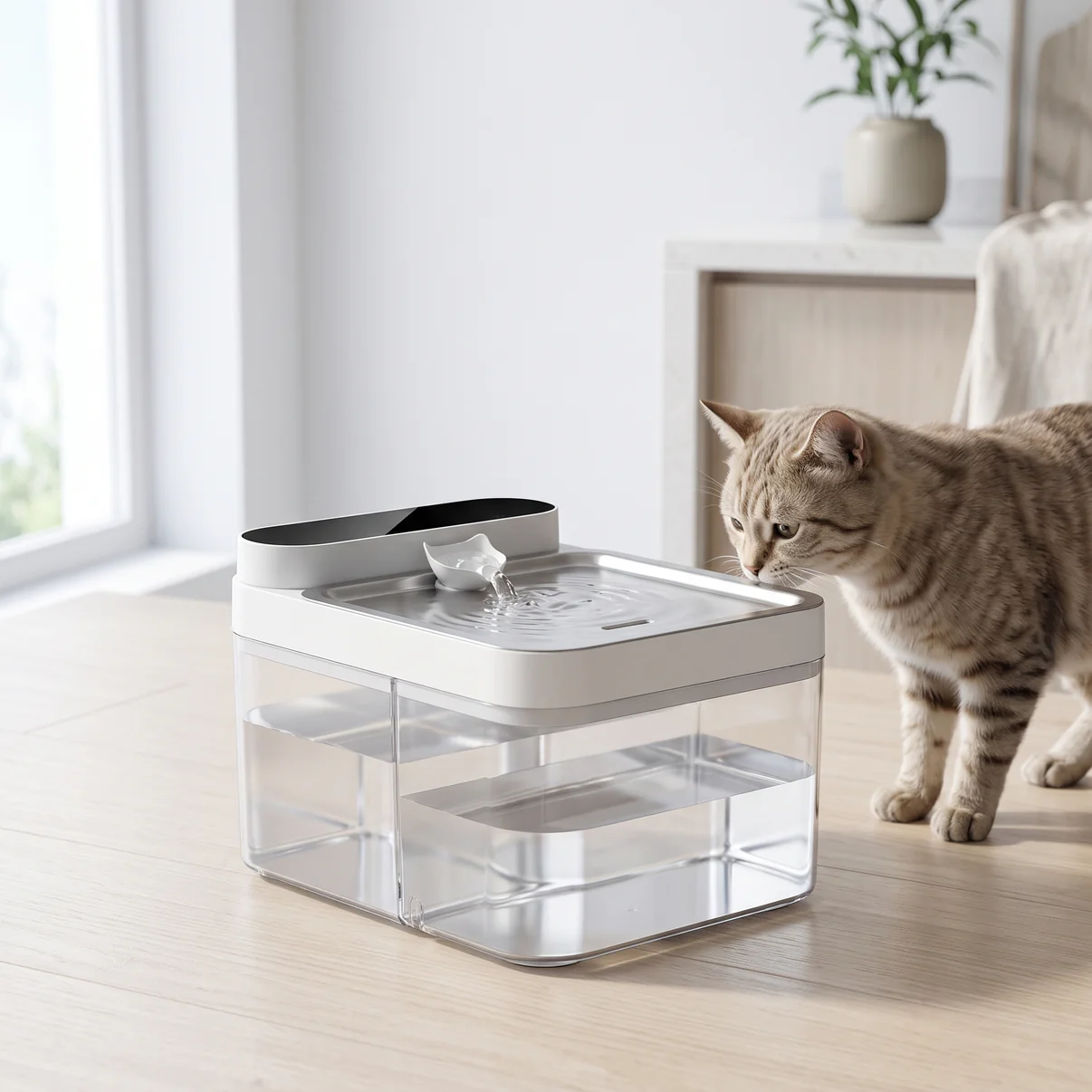
HydroPurr
The only fountain that doesn't recirculate
Our Grade
A+
Score
9.8/10
★★★★★
Price: $179.95 |Availability: Online only (HydroPurr direct)
Capacity
3L (~101oz) clean tank + separate wastewater collection
I almost skipped this one — it sounded too simple to be real. A friend described it as "a cat fountain with no filter and no recirculating pump," and my first thought was how does a fountain with no pump and no filter keep the water fresh?
Every fountain I've owned just pushes the same water around in a loop, through a filter, day after day. This one skips all of that.
And that simplicity made me suspicious — an idea this obvious usually has a catch.
But the answer turned out to be almost stupidly simple: you don't need a loop if the water is always new.
Here's what actually happens inside a HydroPurr. There's a clean water tank on one side and an empty wastewater reservoir on the other. When your cat approaches, the fountain dispenses a small, fresh amount of water into the drinking bowl. Whatever your cat doesn't drink — the water that's been sitting there long enough to pick up saliva, fur, ambient bacteria, whatever — quietly drains away into the waste side. Next time your cat comes back, they get new water. Not filtered recycled water. New water. Like a faucet that knows when to turn on.
And this is where the whole category suddenly cracks open.
Because once you understand this, you start asking the right question about every other fountain you've ever owned: wait, so where did yesterday's water go? Answer: it's still in there. It's been cycling through a filter and your cat's mouth and back into the bowl for days. That's what the slimy film is. That's why the water smells weird by day four. That's why there's a visible ring on the inside of the reservoir no matter how new the filter is. The filter was never the solution. Recirculation was the problem.
Think about your own home for a second. The water you use never comes back to you — it goes down the drain, off to a treatment plant, and what comes out of the tap is genuinely new. We would never drink the same water twice. But that's exactly what a recirculating fountain asks your cat to do, every single day. And that tiny carbon filter? It doesn't clean anything — it can't remove the bacteria, it just softens the smell while the same saliva, fur, and slime keep looping back through. A cheap filter doesn't fix recycled water. It just hides it.
A quick note on materials: HydroPurr's clean and waste tanks are BPA-free food-grade plastic — you need something lightweight and transparent so you can actually see water levels at a glance. But here's the difference that matters: the water in the clean tank is only in there until the next dispense. It's not sitting, warming, growing biofilm, or picking up saliva for a week. And the drinking bowl — the part your cat's mouth actually touches — is real 304 stainless steel. That's the opposite of a fountain that markets "stainless steel" because the top plate is steel while the water sits in a plastic reservoir for seven days getting recirculated through a pump.
How It Works
1
Clean Tank
Fresh water waits in a sealed reservoir the cat can’t reach — and nothing ever flows back into it.
2
Fresh Bowl
Your cat approaches. A small, fresh pour is dispensed into the stainless steel drinking bowl.
3
Waste Drain
Leftover water drains into a separate waste reservoir. Next sip? Brand new water again.
What It's Actually Like to Own
After six weeks of testing, I have notes in my log that read like this:
Week 1: No slime. None.
Week 3: Still no slime. Cleaned it anyway, because habit. Took four minutes.
Week 5: Filled the clean tank. Emptied the waste reservoir. Total hands-on time: under two minutes.
Week 6: My older cat's water intake (tracked via a smart scale on her other bowl) is up roughly 40% from baseline.
The stainless steel drinking bowl is dishwasher safe. There are no filter cartridges to buy, ever. The battery lasts a month or more on a charge, so it works through power outages without missing a beat. It's silent — genuinely silent, not "silent at first and then buzzy at week six."
If you're like most people reading this, you've probably spent $300–$500 on fountains already. I did the math on what the HydroPurr actually costs per day of ownership versus what you'd spend on a plastic fountain plus filters plus pump replacements plus the one you'll throw in the trash when the motor dies: HydroPurr pays for itself inside 14 months, and costs nothing after that.
The way I look at it, this isn't really a purchase — it's a long-term investment. You pay once and you're done: years of genuinely clean water every day, no filters, no replacements, no hassle. Spread over that long, it's one of the smallest things you'll ever spend on your cat — and nothing matters more than keeping the ones you love healthy and happy.
What Buyers Actually Say
From the HydroPurr review page, paraphrased (real reviews, consolidated):
"Five cats in this house, and we've cycled through more fountains than I can count. This is the only one where I've never once seen slime."
"My husband thought I was crazy for spending this much on a cat fountain. Six months in, he admits it was the best money we've ever spent on the cats."
"I had her on sub-Q fluids for kidney issues. After switching to this fountain and getting her water intake up, my vet took her off them."
Biofilm Buildup (less slime = higher)10.0
Actual Material9.2
Cleaning Burden (easier = higher)9.8
Annual Filter Cost (cheaper = higher)10.0
Mechanism Reliability9.5
Noise (quieter = higher)9.9
What We Liked
Dispenses genuinely new water each time — zero recirculation, zero slime
True stainless steel drinking bowl (no plastic in the water path)
Wireless, rechargeable — works through power outages for weeks
Zero filter subscription. None. Ever.
Whisper-quiet operation, under 25 dB
Dishwasher-safe bowl; total weekly hands-on time under 3 minutes
Pays for itself inside 14 months versus plastic-fountain + filter costs
The Honest Downsides
Not the cheapest fountain on this list — you're paying for engineering, not a plastic bowl
Waste reservoir needs emptying every few days (about 20 seconds)
Optimized for 1–3 cats; 4+ cat households may want two units
Online only (not sold in retail stores)
Bottom line: If you've been burned by plastic fountains and "stainless steel" marketing and $80-a-year filter subscriptions, this is the first product I've tested that's built around solving the real problem instead of engineering a prettier version of the same broken system. It's not the cheapest. It's the only one I'd buy again.
Free shipping over $49 · 60-day satisfaction guarantee · 4.7★ from 2,000+ verified buyers
#2 — Closest Real Competitor
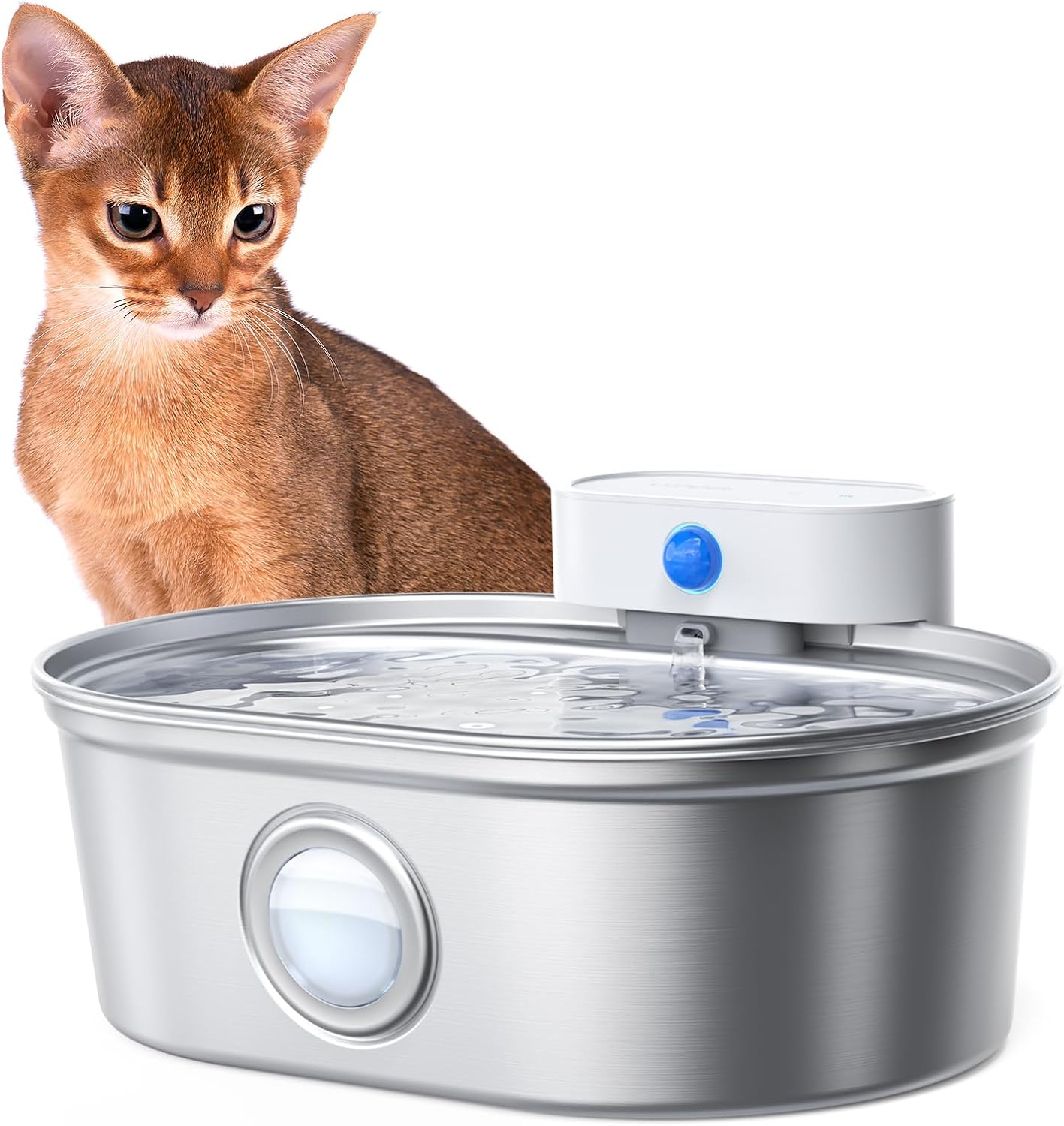
Wireless Stainless Steel Fountain
The closest real competitor we tested
Our Grade
B+
Score
8.4/10
★★★★★
Price: $59.99–$79.99 |Where: Amazon
Capacity
2L (67oz)
Material
304 stainless steel bowl and tank; external plastic pump
Power
Wireless, 5000mAh battery (100–120 days standby)
Filters
7-layer proprietary, every 2–4 weeks
Noise
≤30 dB
Our Take
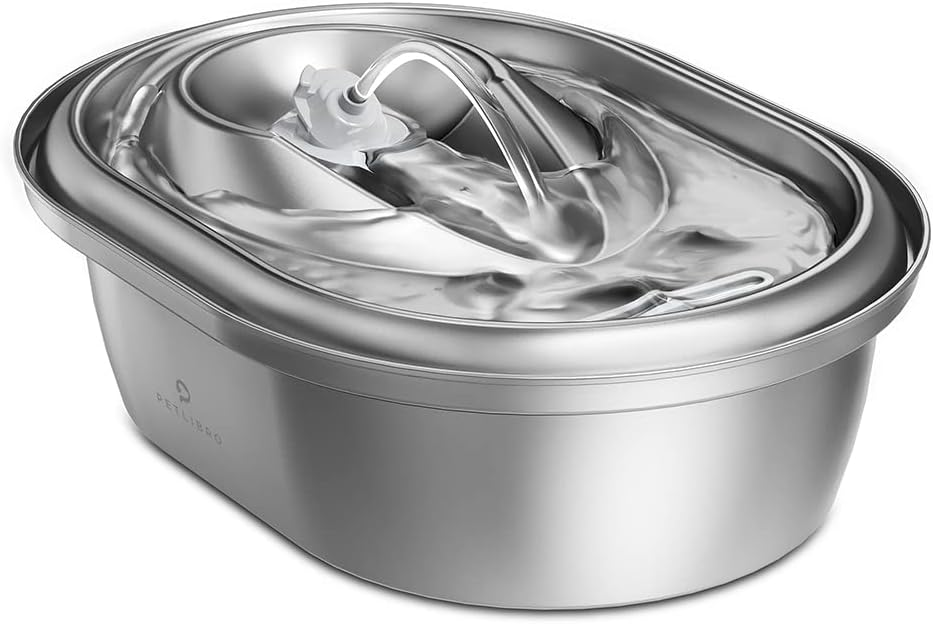
I'm going to be straight with you: if the HydroPurr didn't exist, this would be my pick. This one got a lot of things right that most of the category still can't crack.
The stainless steel is real stainless steel, not a decorative top plate hiding a plastic bowl underneath. The pump is genuinely external — it sits outside the water tank on its own base, which means no cord in the water, no cord for your cat to chew, no electric shock risk, no motor slowly leaking plastic particles into the drinking water. The battery lasts months on a single charge, so power outages aren't a concern. It runs at 30 dB or lower, the bowl goes in the dishwasher, and the whisker-fatigue problem most cats have with deep bowls is solved by a wide, shallow drinking tray.
Most of what this fountain claims, it delivers. That's rare in this category.
So Why Not #1?
Two reasons.
First: It still recirculates water. That 7-layer filter is impressive on paper, but the water your cat drinks at 3 p.m. is the same water that was in the bowl at 10 a.m. — minus whatever the filter managed to catch. The saliva, the shed hair, the invisible particles from your cat's chin and paws and tongue — all of that cycles through. The filter cleans it, yes, but cleaning recycled water is fundamentally different from dispensing new water. Once you see the difference, you can't unsee it.
Second: You're still on the filter subscription treadmill. Roughly $40–$75 a year, forever, in proprietary cartridges. Over the five years I'd expect this fountain to last, that's an extra $200–$375 on top of the sticker price. And when the battery eventually dies — which is not user-replaceable — the whole unit becomes disposable.
Biofilm Buildup (less slime = higher)6.5
Actual Material8.8
Cleaning Burden (easier = higher)7.8
Annual Filter Cost (cheaper = higher)6.0
Mechanism Reliability7.5
Noise (quieter = higher)8.6
What We Liked
Real 304 stainless steel — not a decorative top plate
Still recirculates water — same stale-water problem at root
Proprietary filters every 2–4 weeks ($40–$75/year forever)
Non-user-replaceable battery — whole unit eventually disposable
7-layer filter cleans, but doesn't solve the recirculation issue
Bottom line: Genuinely good fountain. If the idea of a fountain that dispenses brand-new water each time makes no sense to you, this is where to buy. If the idea of a fountain that dispenses brand-new water each time does make sense to you, you already know what's at #1.
The old-school design with the nicest surprise and the biggest annoyance
Our Grade
B−
Score
7.2/10
★★★★★
Price: $79.95–$99.95 |Where: Amazon
Capacity
128oz (1 gallon)
Material
Stainless steel outer bowl and center cylinder; plastic pump housing, plastic filter housing
Power
Plug-in only
Filters
Two types (carbon every 2 weeks + foam every month)
Noise
Moderate
Our Take
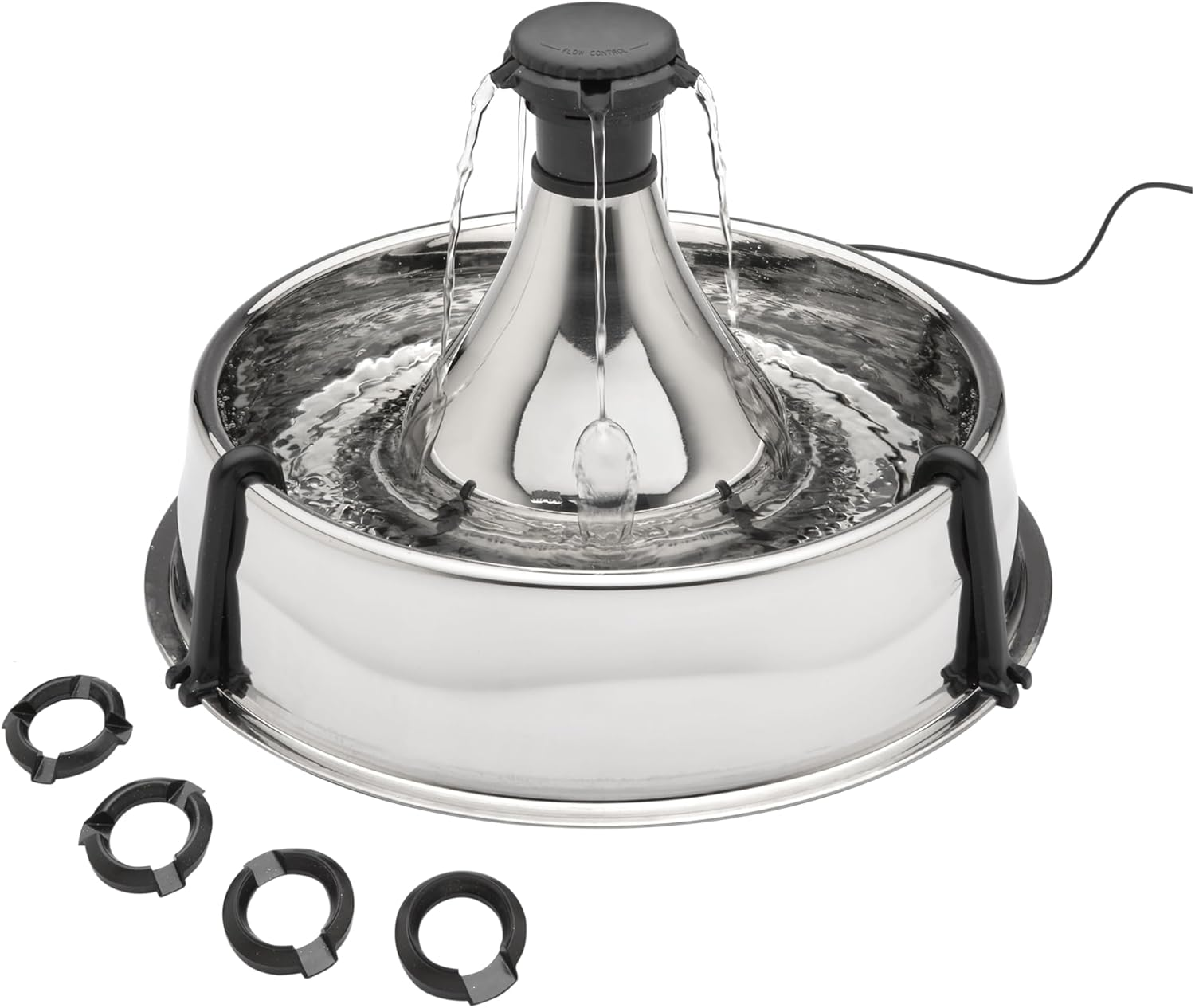
This is one of the oldest designs on the list — it's been around since before half these fountains existed — and it has one genuinely excellent feature that nobody else here (except HydroPurr and the #2 pick) can match: if the power goes out, your cat still has water. Gravity keeps the outer bowl full even when the pump stops. That matters in a category where most fountains turn into inaccessible plastic boxes the second the electricity hiccups.
The bowl is dishwasher safe (top rack). The 128oz capacity is genuinely huge — ideal if you have two cats and a dog all sharing one source. And the five interchangeable spout rings let you adjust how many water streams you want and how strong each is, which is useful for skittish cats who get spooked by strong flow.
Where It Goes Wrong
Two places, both fatal for a lot of buyers.
One: The "stainless steel" is decorative. The maker confirms it in their own FAQs — the pump and filter housing are plastic. So while the outer bowl is steel (real steel, not a lid), the water is still passing through plastic components before it gets to your cat. Same halo trick, slightly more honest execution.
Two: The maintenance cycle is brutal. The maker's own support documentation requires the pump to be cleaned every two weeks to prevent clogging. Not "recommended." Required. Buyers who skip this cycle describe the pump dying or the sponge inside the pump literally disintegrating into the water. One verified buyer wrote: "the sponge started disintegrating and I'm convinced it partly lodged into the pump itself… just a nightmare of a fountain."
Add two filter types ($42–$71/year combined) and a cleaning routine that requires you to wrestle three plastic clips off a center cone every 14 days, and you've got a fountain that works well — if you're willing to babysit it.
Biofilm Buildup (less slime = higher)5.0
Actual Material6.0
Cleaning Burden (easier = higher)4.8
Annual Filter Cost (cheaper = higher)6.0
Mechanism Reliability7.8
Noise (quieter = higher)6.5
What We Liked
Gravity keeps the outer bowl full during power outages
128oz capacity — great for multi-pet households
Dishwasher-safe (top rack)
Five interchangeable spout rings for flow control
Based on a design that's been around 15+ years
What Held It Back
"Stainless steel" is decorative — pump and filter housing are plastic
Required pump cleaning every 2 weeks (not optional)
Two filter types to buy: $42–$71/year combined
Pump sponge reported to disintegrate if neglected
24 full cleaning cycles per year
Bottom line: The best pick if power outages are your #1 concern and you don't mind a committed maintenance schedule. Otherwise, you're paying $90 for a fountain that demands 24 cleanings a year.
The best-looking fountain that isn't really stainless steel
Our Grade
C+
Score
6.5/10
★★★★★
Price: $39.99 direct / $38–$45 Amazon |Where: Amazon
Capacity
2.1L (71oz)
Material
ABS plastic body with stainless steel top plate
Power
Plug-in only
Filters
Proprietary, every 1–3 months
Noise
~30 dB
Our Take
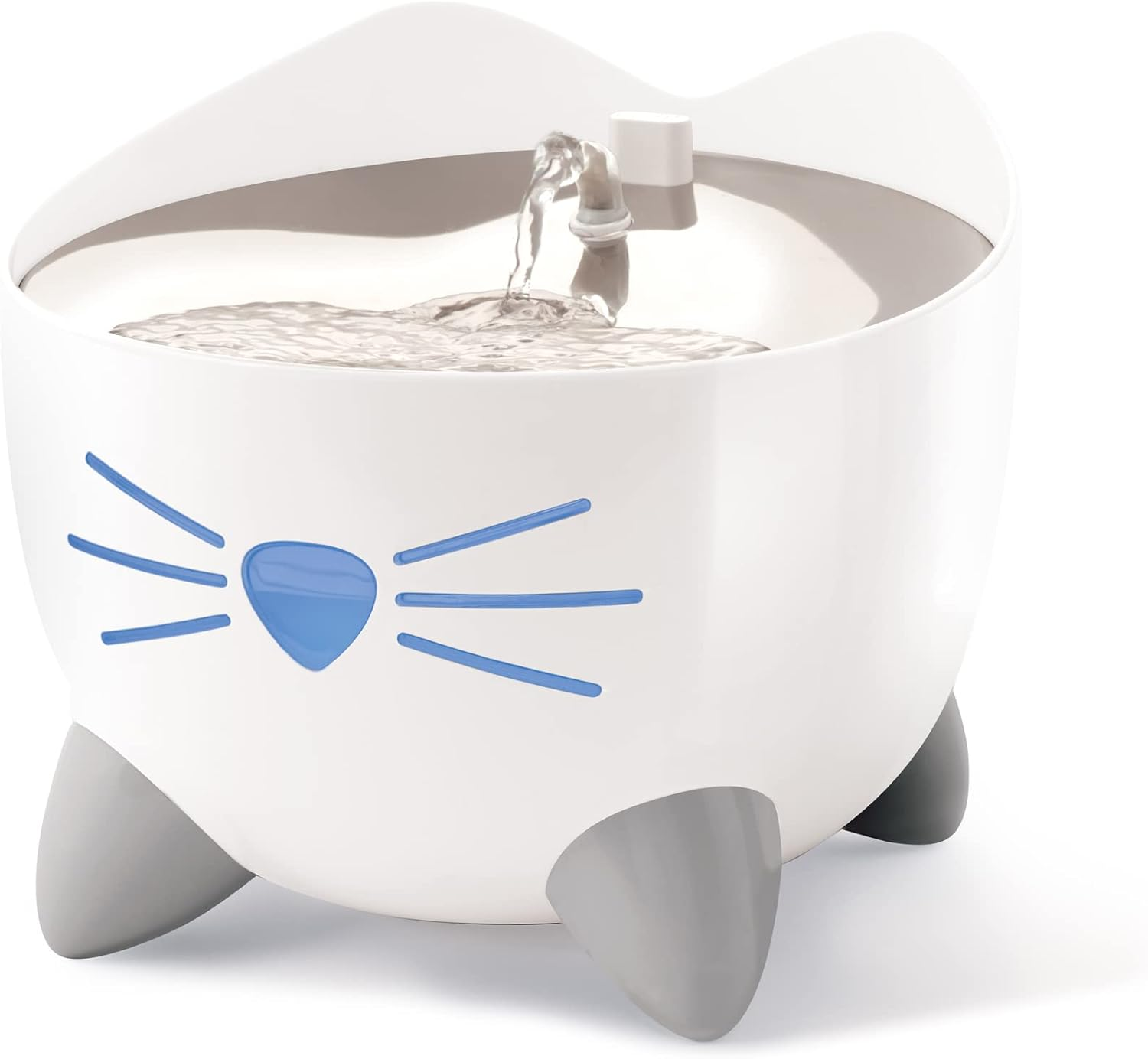
I want to like this fountain. The marketing is immaculate. The packaging makes you feel like you're unboxing a $200 product. It looks expensive. It photographs well. And at $39.99, the price-to-perceived-quality ratio is the best in the category.
Then you take it apart.
The body is ABS plastic. The reservoir is plastic. The filter chamber is plastic. The pump well is plastic. The "stainless steel" is a single top plate covering the drinking area. Water touches plastic through roughly 90% of its journey through this fountain. Hands-on reviewers put it plainly: ABS is porous compared to stainless steel, which means biofilm and chin acne are still on the table.
The other issue is the pump. I could show you dozens of reviews describing the exact same pattern: works great for one to three months, then dies, replaced under warranty once, dies again, and you're done. The maker even sells replacement pumps for $9.99 — honest of them, but a sign they know the pumps fail.
Filters run $22.94 for a 4-pack at the recommended 1–3 month cycle, which works out to $48–$96 per year in ongoing costs.
Biofilm Buildup (less slime = higher)4.0
Actual Material3.8
Cleaning Burden (easier = higher)6.8
Annual Filter Cost (cheaper = higher)5.0
Mechanism Reliability4.5
Noise (quieter = higher)7.0
What We Liked
Best price-to-perceived-quality in the category at $39.99
Excellent packaging and visual design
Affordable $9.99 replacement pumps
Filters are a reasonable 1–3 month cycle
What Held It Back
"Stainless steel" is only the top plate — ~90% plastic water path
ABS plastic is porous; biofilm and chin acne still on the table
Pump failure pattern reported repeatedly at 1–12 months
$48–$96/year in proprietary filter costs
Plug-in only — no power-outage behavior
Bottom line: If you want the look of a premium stainless steel fountain and you're okay with the reality being mostly plastic, this is the prettiest version of that trade-off. But if you bought it expecting stainless steel water contact, you didn't get it.
This one did one thing better than almost anyone: it separated the pump from the bowl. You can lift the drinking bowl right off the base without juggling a cord, which makes cleaning and refilling genuinely faster than the standard submerged-pump design. In a quiet house at 2 a.m., this is one of the quietest fountains I tested.
But it's all plastic. Every part. And the manufacturer explicitly says none of it is dishwasher safe — which is a dealbreaker for anyone who picked up a fountain specifically because they were sick of hand-scrubbing plastic bowls.
Its buyer rating sits at 3.1 out of 5 — the lowest of any product on this list. Overflow complaints and pump-stops-pumping complaints are frequent. The filter runs about $40–$60/year.
Biofilm Buildup (less slime = higher)4.2
Actual Material3.2
Cleaning Burden (easier = higher)5.8
Annual Filter Cost (cheaper = higher)6.0
Mechanism Reliability4.5
Noise (quieter = higher)8.5
What We Liked
Pump separated from bowl — easier daily handling
One of the quietest fountains tested (≤25 dB)
Lift-off bowl design speeds up refills
What Held It Back
Full ABS plastic construction
Not dishwasher safe — hand-wash only
Buyer rating of 3.1/5 — lowest on this list
Frequent overflow and pump-stops-pumping complaints
$40–$60/year in filters
Bottom line: Smart design idea, underwhelming execution. If silence is your only criterion and you can ignore the plastic, fine. Otherwise, skip.
Polypropylene body; stainless top-plate variant available
Power
Plug-in only
Filters
Triple-action filter, every 30 days
Noise
Quiet when new
Our Take
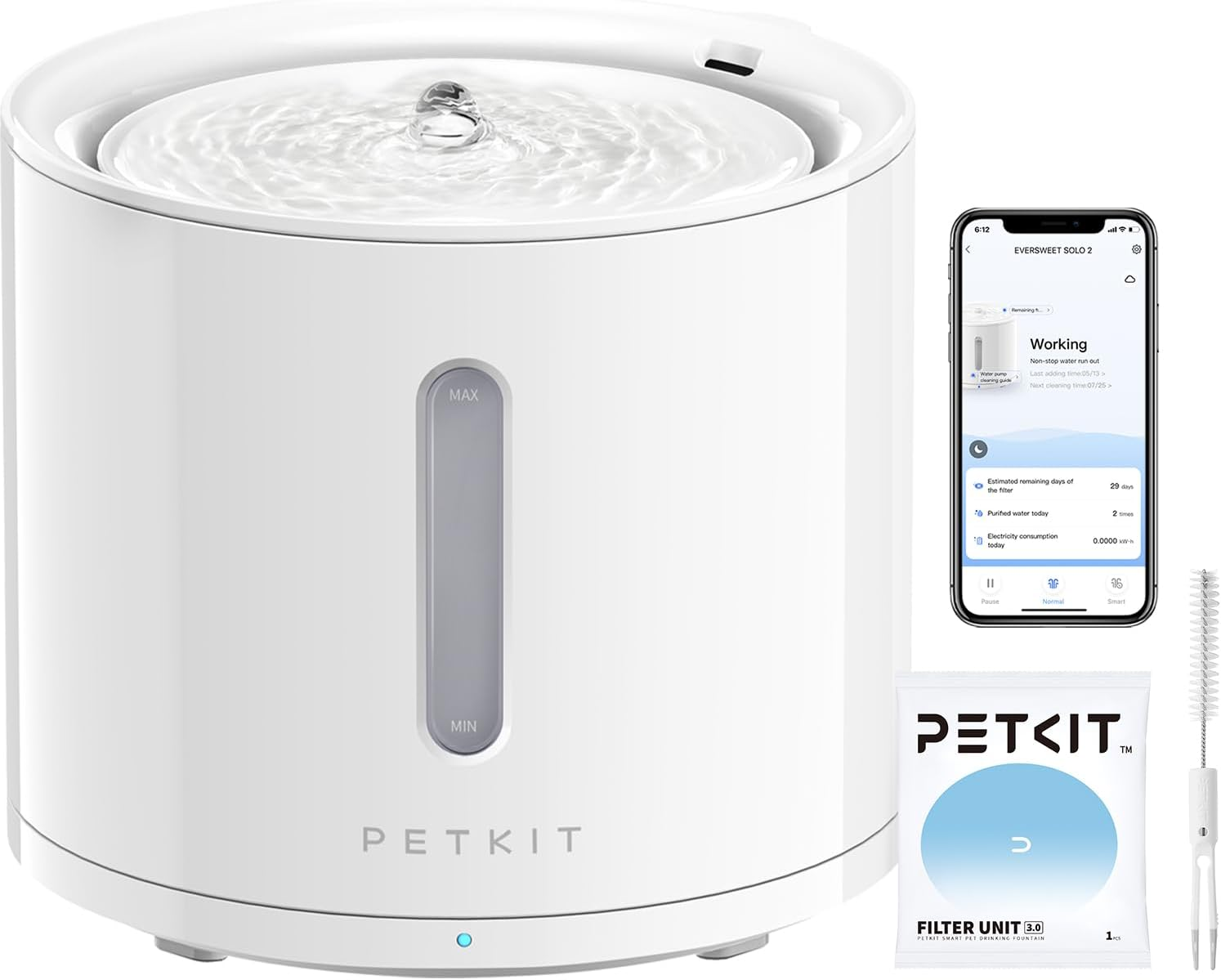
UV-C sterilization is a cool feature. An app that tracks your cat's drinking is a cool feature. The face design is cute. On paper, this one checks boxes nobody else in the category checks.
In practice, the app doesn't pair. Testers waited over an hour for a "three-minute" setup. The fountain pauses in normal mode for no reason and has to be unplugged and replugged to restart. Reviews are full of buyers who found it stopped working entirely when they upgraded their home WiFi router. The pump fails in the three-to-six-month window in a high percentage of reviews, and its customer service is the lowest-rated on this list.
Also — UV-C kills bacteria, but it doesn't remove saliva, fur, or the metabolic byproducts of recirculated water. It's a band-aid on the wrong wound.
The six contenders across the six criteria that actually matter.
Fountain
Price
Stainless Drinking Surface?
Filter Cost/Yr
Pump Failure Window
Power Outage?
Editor Score
HydroPurr
$179.95
✓ Yes + no recycled water
$0
No pump to fail
✓ Yes (wireless)
9.8
Wireless Stainless Steel
$60–$80
✓ Yes
$40–$75
Reports at 6 mo
✓ Yes
8.4
Stainless 360° Tower
$80–$100
⚠ Partial
$42–$71
Multi-year w/ care
✓ Yes (gravity)
7.2
Stainless-Top Capsule
$39.99
✕ No (top plate only)
$48–$96
1–12 mo
✕ Minimal
6.5
Quiet Plastic (Detachable)
$50–$70
✕ No
$40–$60
~6 mo
✕ No
6.0
Smart UV-C / App
$60–$75
✕ No
$60–$80
3–6 mo
✕ No
5.5
Editor Score is weighted across all six testing criteria.
Why This Matters
Why Your Cat's Hydration Matters More Than You Think
You probably already know this part, but it's worth saying out loud.
Cats evolved from desert animals. In the wild, their ancestors got nearly all their water from the meat they ate, and they instinctively avoided standing water because it was more likely to be contaminated. That evolutionary code is still alive inside your cat, which is why most cats are chronically under-hydrated and why so many develop kidney disease, urinary tract infections, and crystal formation as they age.
The numbers are hard to look at. Kidney disease is the leading cause of death in cats over 10. A fountain won't prevent it in every case — genetics and diet matter too — but dehydration is the single biggest risk factor you actually have control over.
A fountain matters because cats instinctively trust moving water. Running water is audible, visible, and smells cleaner to them than a stagnant bowl. When you put a working fountain in front of a cat who isn't drinking enough, their intake often goes up 30–80% inside the first two weeks.
Which means your choice of fountain — and whether the one you pick keeps working six months from now — is genuinely a health decision. Not a "nice thing for kitty." A health decision.
Buying Guide
What to Look For (and What to Avoid)
What Actually Matters
Trace the water's path. If "stainless steel" only refers to the dish your cat licks, you don't have a stainless steel fountain. You have a plastic fountain with a stainless lid.
Run the annual filter math. If a filter change is "every 2 weeks," multiply the filter price by 26. That's your real annual cost.
Count the parts. Every screw, clip, and gasket is a place biofilm will grow. Simpler designs clean faster.
Check power-outage behavior. If the pump stopping means your cat has no water, you have a problem waiting to happen.
Ask whether the water is new or recycled. This is the question nobody thinks to ask until someone points it out.
What to Walk Away From
"Stainless steel" claims that don't specify which components are steel and which are plastic
Proprietary filter subscriptions that force a 2-week replacement cycle
Fountains whose pump cord is hard-wired and non-replaceable
Smart fountains that require an app to function (when the app breaks, the fountain breaks)
Any fountain whose cleaning instructions involve the word "disintegrating"
FAQ
Frequently Asked Questions
Will my cat actually drink from a fountain?
Most cats adapt within 24–72 hours. Some take a week or two. Every fountain in this review is designed to make the transition easier, but the HydroPurr's motion-dispensed flow is particularly good at replicating the "faucet cat" experience most skittish drinkers already prefer.
Do I really not need filters with the HydroPurr?
Correct. The HydroPurr's design separates clean water from waste water — the water your cat drinks was never in contact with your cat, fur, saliva, or recirculated debris, so there's nothing to filter. You just refill the clean side and empty the waste side.
What if my cat doesn't take to it?
HydroPurr offers a 60-day satisfaction guarantee. If your cat won't drink from it, you can return it.
How often do I actually need to refill it?
For one or two cats, every 5–7 days for the clean tank. The waste reservoir needs emptying every 3–4 days. Total hands-on time: under 3 minutes.
What happens during a power outage?
Nothing. The fountain is battery-powered and runs for weeks on a single charge. Your cat doesn't notice the power is out.
Is it loud?
No. Under 25 dB. In a quiet room, you have to put your ear near it to hear anything.
Is it fully stainless steel?
The drinking bowl — the part your cat actually drinks from — is 304 stainless steel. The clean water tank and waste reservoir are food-grade BPA-free plastic (you need a lightweight, transparent material to hold the water and monitor levels). The critical difference is that water doesn't sit in those tanks for days recirculating — fresh water dispenses, old water drains away. So your cat is never drinking water that's been marinating in plastic the way it does in a traditional recirculating fountain.
What if the product stops working?
60-day satisfaction guarantee plus an extended warranty through the brand. If anything fails, you're covered.
Our Verdict
The Verdict
I've tested cat fountains for over a decade. I've owned most of the products on this list at one point or another. And I can tell you honestly that until HydroPurr, I accepted the slime, the filter subscriptions, the mid-life pump failures, and the dishwasher-not-safe plastic as the cost of doing business with cat water fountains. I assumed they were just like that.
They're not. They're like that because the category has been stuck on the same flawed premise — recirculate and filter — for fifteen years. The HydroPurr is the first fountain I've used that questions the premise itself, and once you see it work, you can't go back.
If you're a first-time fountain buyer: skip the $30 plastic fountain. You'll replace it in six months and end up here anyway.
If you've been burned by two or three fountains already: this is the one that ends the cycle.
If your cat has kidney or urinary issues and hydration is a medical concern: this is the one your vet would want you to have, if vets recommended specific products.
★ Our Top Pick
HydroPurr
Only fresh water reaches the bowl. Used water drains away for good.